This semester's field experience was especially meaningful for me, not just because it was my very last field experience, but because I found out that the 4th graders I was spending 3 weeks with will be MY 5th graders next year! I could not be more thrilled. The school where I am teaching next year (as an intern) is a dual language immersion school. Come fall, I will have TWO classes of spunky, smart 5th graders who will be looking to me to guide their learning for the year. I feel so blessed that I got to spend 3 weeks with them, getting to know their names and little tidbits about them.
Now that I have names and faces to put to my future students, all of the sudden, everything feels more real! I am already turning over their unique needs in my mind, trying to think of ways that I can meet those needs as a teacher. I have a few students with academic issues. I have a few more with behavioral challenges. I know that throughout the year, as I get to know them better, their individual needs will become even more apparent to me,
It feels a little overwhelming.
As I was reviewing my notes from my differentiation textbook reading, in preparation for continuing this blog, I came across a list of elements of teacher responses to student needs. The element that stood out to me is number 5, the response of reflection.
One thing that I discovered in field was that I LOVE having 2 classes. Why? Because it gives me a built-in opportunity to reflect on my teaching experiences. I would teach a lesson in the morning, and then, during lunch, I would discuss with my cooperating teacher what went well, what didn't go so well, and how I can make it even better for the afternoon class. Having 2 classes also gave me a chance to practice differentiating to meet student needs, because the classes each had their own unique challenges, both as a whole and for individual students. Although it takes some time and some honest self-evaluation, I know that reflecting on my teaching practice makes me a better teacher.
Recently, I was able to visit Washington, DC. In the Smithsonian Air and Space Museum, I found a poster that I think is perfect for me as I move forward in my teaching career. Tomlinson even mentions the sentiment in her book: Failure is not an option. It just isn't. I hope that this poster serves as a reminder to me as a first year teacher to always be reflective and honest with myself so that I can meet my students' needs.
.
Showing posts with label responsive teaching. Show all posts
Friday, April 17, 2015
Monday, March 2, 2015
Demanding Curriculum
My son has always been an excellent speller. In fact, it’s been a pretty rare occasion that we even have to practice his weekly spelling words. There was a short period of time where I was a real stickler about it, but it didn’t take me long to realize that it really wasn’t necessary for him. He would often get 100% on the pretest, and if he didn’t, whatever practice exercises they did at school were enough that he would usually ace the final test on Friday.
As a parent, I wished that he were more challenged in this area. He would often mention to me that the spelling tests were “dumb”, and I can’t say I blame him. It’s hard to feel like something is worthwhile when it takes that little effort.
In my first field experience as a junior in the elementary ed program, I was able to work with an amazing fifth grade teacher named Michelle. I learned so much from her, but one thing I especially loved was that way she handled weekly spelling words. She gave an assessment at the beginning of the year to find each child’s level, and she went from there. Each child had their own unique, personalized spelling list each week, depending on where they were. At first, I couldn’t understand how she possibly had time to do that for her large class of 30+ students, but I soon learned that it was because she was so organized about it, and because she delegated as much of the work to students as possible. Students were responsible for helping one another practice words throughout the week, and even giving each other the spelling test on Fridays, as well as grading. Michelle would monitor and check the student’s work, of course, but it was awesome to see how much responsibility the students were able to take on. I wish I could’ve been there to see it all from the beginning of the year. The bottom line is, there was not even one student in her class who was not challenged by their spelling words each and every week. When they did well on a test, they knew it was because they studied hard and earned it. Further, they all felt a sense of accountability for making sure that their spelling time ran smoothly.
Tomlinson says, “Demanding curriculum and instruction also means the teacher ensures that every student develops the habits of mind necessary for success in school and life.” I got to see this in action in Michelle’s class, and it was an amazing thing!
Pinterest for the WIN!
Like so many other American women, I'm a little bit addicted to Pinterest. I'd probably be ashamed if I actually knew how many hours I spend on it every week (yes, that's hours, not minutes...)
BUT--it's not all bad! For instance, it's a fantastic way to connect with other teachers and take advantage of their ideas and experience.
Just the other day, I found this awesome infographic about differentiation! So much wonderful information in an esthetically pleasing layout!
Here it is:
(Credit: ASCD)
Overall, I feel like Tomlinson would agree with the above assessment of differentiation. After all, she said,
"The idea of differentiating instruction is an approach to teaching that advocates active planning for and attention to student differences in classrooms, in the context of high quality curriculums."
Tuesday, February 10, 2015
Classroom Environment
Creating a positive classroom
environment is vital. It establishes the tone and atmosphere is which teaching
and learning will happen. Tomlinson says that the classroom environment will
“support or deter the student’s quest for affirmation, contribution, power,
purpose, and challenge in the classroom” (pp. 37). Walls, furniture arrangement, bulletin
boards, artifacts, materials, charts, posters, learning materials, and exhibits
are all part of the classroom environment. Students, parents, and colleagues
can get a sense right away of the teacher’s personality and goals by examining
the classroom environment.
However, the classroom environment
is more that just physical attributes. The affective attributes are just as
important. The teacher’s demeanor and interactions with students play a huge
role in the classroom climate. Do the students have a voice in the classroom?
Are they seen as individual learners? Does the teacher take time to get to know
students individually? Are individual cultures and learning styles respected?
These are questions that every teacher must honestly consider.
Below are a few of my favorite
ideas and tips for creating a positive classroom environment:
Physical Environment
· Represent various cultures and backgrounds through books, posters, and décor
· Make space in the room for all kinds of learners, including students who need quiet and those who need interaction
· Commend creativity by providing many materials for students to work with
· Use lots of color and interesting things to look at in the classroom
Affective Environment
· Call on students equitably
· Teach multiple perspectives
· Create opportunities for students to get to know one another and form connections
· Use exit slips, journals, or class meetings to give students a safe place to communicate with the teacher and express concerns
Tuesday, February 3, 2015
Responsive Teaching AMAZING Idea: Interactive Science Notebooks
In the science methods class I'm taking, we are learning all about interactive science notebooks! I absolutely LOVE this idea and I can't wait to do these with my future students! I am lucky enough to have the author of this blog as a professor (also see her blog button in my sidebar.) Every week in class, we do a science activity or experiment, and then we create a few pages in our notebooks to go along with what we did.
Here are just a few pages I've done in my notebook so far:
This is a sort we did to classify magnetic vs. nonmagnetic objects.
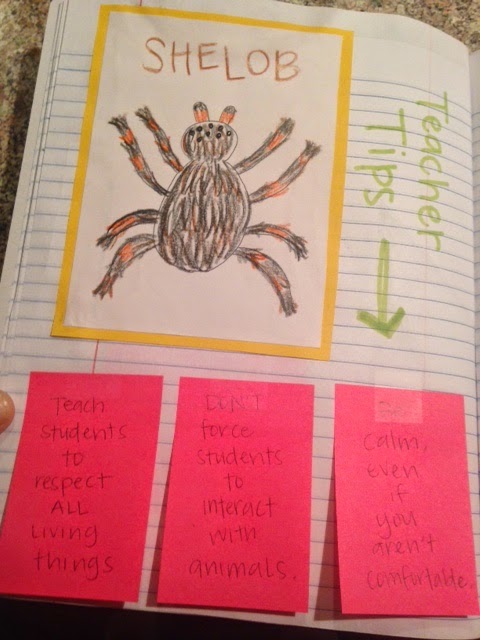
A drawing of a spider we observed in class, as well as some teaching tips.
An owl foldable! Inside is information I learned about owls in class that day.
A cute traffic cone foldable. The bottom part slides out. We learned about the center of gravity.
The connection: How are interactive notebooks related to differentiation and responsive teaching? I can think of several ways.
1. The notebooks are a kinesthetic activity. Students who really enjoy doing hands-on learning will love the interactive notebooks, as well as students who are artistic, and/or students who love writing. Many different talents and strengths can be utilized in the notebooks.
2. Interactive notebooks are very personal and give students a sense of ownership over the material they learned. Students are more motivated to learn when they can take pride in the work they are doing.
3. Interactive notebooks allow for creativity in synthesizing information. Students can represent their learning in a way that is meaningful and memorable to them personally.
4. The notebooks give teachers a window into students' minds. Teachers can use them to evaluate student learning and adjust future lessons accordingly.
5. Interactive notebooks help students succeed by working a wonderful review and study guide. It also helps students to retain the information they learned because they extended, responded, and evaluated what their learning when they created the pages in their notebooks.
I'm sure there are many other ways in which interactive notebooks relate to differentiation and responsive teaching, but those are the reasons that really stand out to me. I can also imagine how great it will be to send the notebook home at the end of the school year, and give the students the chance to show their parents the wonderful things they did in science! I'm so excited to use interactive science notebooks in my future classroom.
Responding to Student Needs
As a pre-service teacher, I have a clear vision of my ideal future
classroom. I imagine that it will be a place where each child feels accepted,
needed, and respected. I picture my students feeling excited to come to
school, and looking back on their days with a sense that their time in class
was well-spent. I can see myself losing sleep some nights, stewing over an
issue in class or with a student. In my classroom, I envision students feeling a
sense of ownership for making our days run smoothly. I can see them glowing
with pride when they complete a difficult assignment or successfully lead a
class activity. And, all the while, I am standing there beside them, wondering
what the next step will be, and how we can take our classroom practices to an
even higher level.
I know that in reality, the picture of my future classroom
won’t be quite so glowing. I will deal with students who are unruly,
unmotivated, and distrustful. Not all of my lesson plans will be a hit. Some
days, I will be tired and burned out and I’ll wonder why I even bother doing what I do.
Even still, I hope that I can always keep my vision of my ideal future
classroom. I know that it will evolve over the years, and that’s a good thing.
I’m guessing that just when I start to think that I’ve seen it all, a new
student will come along and challenge me in ways I never could’ve imagined.
In my vision of my future classroom, I am a teacher who
understands her students’ needs and responds to them. Tomlinson says there are
5 main ways in which teachers respond effectively. I have listed them and given a brief
explanation of each.
1. Invitation: This first response must be issued from the
time the student enters the classroom. The teacher’s demeanor, words, and
actions all contribute. In order to help the child feel like they belong, the
teacher must get to know the child as a whole person.
2. Opportunity: Amazing teachers ensure that the materials,
tasks, applications, and problems in their classrooms are rich with meaning and
possibilities.
3. Investment: Teachers must be invested in both their
students and in the content they are teaching. When teachers share thoughts
with their students about the classroom, they are showing the students that
they are invested in them.
4. Persistence: There is no finish line in education.
Responsive teachers do not accept excuses, but offer support instead.
5. Reflection:
Reflective teachers create a network of like-minded peers. They utilize
their resources within the school. They never stop learning and are always
seeking to advance their professional knowledge. They are always thinking, “How
can I make this better?”
Subscribe to:
Posts (Atom)